
Desk stretches: 7 you can do without leaving your chair
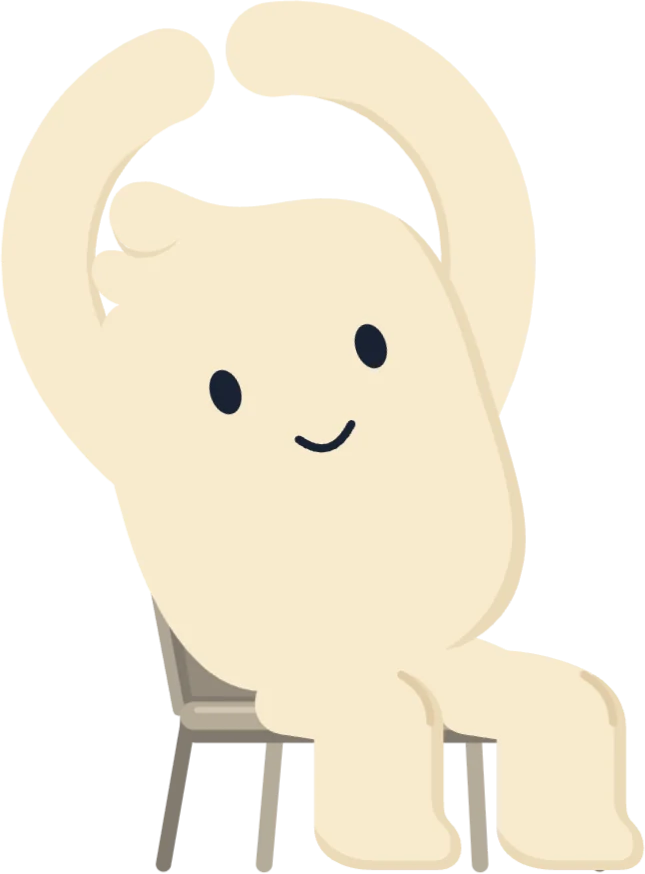
You don't need a mat or a break room. These seven stretches work from top to bottom while you sit: neck, chest, upper back, hips, hamstrings and ankles. They come from NHS and Cleveland Clinic guidance, with the holds and repeats they give.
By mid-afternoon at my MacBook my neck is stiff and my shoulders have crept up. I wanted a short list I could do without standing up or looking odd in a meeting room, so I went to the sources rather than a random video.
Before you start
- Use a steady chair. The NHS suggests a solid chair without wheels, and without arms if you can.
- Gentle, never painful. Cleveland Clinic says stretching shouldn't hurt: listen to your body and stop if you feel pain.
- Not sure it suits you? If you haven't exercised for a while, or you have a condition, the NHS advises checking with a GP or health professional first.
The 7 stretches
- Neck rotation (neck). Sit upright with your shoulders down and look straight ahead. Slowly turn your head towards one shoulder as far as is comfortable, hold for 5 seconds, then come back to the middle. Do 3 each side.
- Chest stretch (chest and shoulders). Sit upright, away from the back of the chair. Pull your shoulders back and down, arms out to the sides, and gently push your chest forward and up until you feel a stretch across your chest. Hold 5 to 10 seconds, 5 times.
- Upper-body twist (upper back). Sit upright with your feet flat, cross your arms and reach for your shoulders. Without moving your hips, turn your upper body as far as is comfortable and hold for 5 seconds. Do 5 each side.
- Seated hip stretch (hips and glutes). With both feet flat, cross one ankle over the other thigh, just above the knee. Gently pull the top knee towards the middle of your body. Hold about 20 to 30 seconds, then swap.
- Hip marching (hips and thighs). Sit upright without leaning back, holding the sides of the chair. Lift one knee as far as is comfortable, then put the foot down with control. Do 5 each leg.
- Seated forward bend (hamstrings and lower back). Stretch one leg out in front, heel on the floor and knee straight. Keep your back straight and lean gently forward from the hips towards your toes. Hold about 20 to 30 seconds, then swap.
- Ankle stretch (ankles and calves). Holding the side of the chair, straighten one leg with the foot off the floor. Point your toes away from you, then back towards you. Do 2 sets of 5 with each foot.
All seven take a few minutes. Cleveland Clinic suggests starting with holds of about 20 to 30 seconds and building up over time.
Does stretching at your desk actually help?
For neck and shoulder pain, there's decent evidence. In a 2016 randomized trial, 96 office workers with neck pain were split into two groups. Both got advice on desk set-up; one group also did neck and shoulder stretches twice a day, five days a week, for four weeks. The stretching group's pain dropped more, and the researchers concluded that a regular stretching programme can reduce neck and shoulder pain.
It was four weeks with one group of workers, so it isn't the last word. But it points the same way as the advice: little and often beats a big stretch once in a while.
Making it a habit
- Pair it with something you already do. Stretch after you send a big email or finish a call.
- Do one or two, not all seven. The neck rotation and chest stretch take under a minute.
- Let something remind you. I built Wellbreak for this: its Stretch reminder waits while you type, holds during calls, and its buddy stretches with you. See the Stretch habit.
Questions
How often should I stretch at my desk?
Often and briefly. In the 2016 trial people stretched twice a day; Cleveland Clinic suggests about 10 minutes of stretching twice a day for flexibility. A minute or two between tasks is a good start.
Should stretching hurt?
No. You should feel a gentle stretch, never pain. Stop if anything hurts.
Can I do these in a meeting room?
Most of them, yes. The neck rotation, chest stretch, upper-body twist and ankle stretch are all small and done sitting down.
Sources
- NHS, Sitting exercises
- Cleveland Clinic, Flexibility exercises and stretches
- Tunwattanapong P. et al., The effectiveness of a neck and shoulder stretching exercise program among office workers with neck pain: a randomized controlled trial, Clinical Rehabilitation, 2016
This guide is general information, not medical advice. If your eyes or body hurt, see a doctor.